
The Rotary's Role in the Creation of UNESCO
Rotary International and UNESCO share a longstanding and fruitful relationship based on common values and goals for peace and sustainable development.
Since its inception, Rotary International has been committed to promoting peace, mutual understanding, and cooperation among peoples, playing a pioneering role in the development of international organizations dedicated to peace since the 1930s.
«Conference of Allied Ministers on Education»
Starting in 1942, in London — even as bombs fell on the city — Rotarians from District 13 brought together education ministers from Allied nations, mainly from occupied countries, who were in exile in London, for a series of conferences.
The initial aim of these meetings was to jointly prepare for the future of education programs in Europe, which were already beginning to be influenced by propaganda: the Conference of Allied Ministers on Education.
During the first session, eight countries were involved: Belgium, France, Greece, Norway, the Netherlands, Poland, the United Kingdom, Czechoslovakia, and Yugoslavia. Then, over the years, many other countries joined the exchanges.


The prospects are broadening
Starting in 1943, governments from all continents took an interest in this initiative, with their representatives observing or participating in the work, including notably the United States and the USSR, but also India, China, Australia, and South Africa.
The arrival of these new participants has considerably broadened the perspectives and ambitions of these conferences, going beyond European educational reconstruction and focusing more globally on the development of peace and understanding among peoples through access to education and culture.
Between 1942 and 1945, 21 general sessions were held, as well as numerous working meetings in committees on a wide range of topics. After three years of work, the 21st and final session brought together 18 countries. Throughout these four years, 21 nations participated in these exchanges.
The realization of an idea
Proposals were made as early as 1944 to create a permanent international organization focused on education, science, and culture as vehicles for peace and mutual understanding.
The following year saw the establishment of the United Nations, whose charter, signed on October 24, 1945, provided for the creation of specialized agencies in its Articles 57 and 63.
On the proposal of the Conference of Allied Ministers on Education, a United Nations Conference for the creation of an educational and cultural organization was convened in London from November 1 to 16, 1945, bringing together representatives from 44 countries. They decided to create an organization that would embody the culture of peace, which would root "the intellectual and moral solidarity of mankind" and, in so doing, prevent the outbreak of another world war. Thus, the UNESCO Charter was signed on November 16, 1945.

UNESCO at the Sorbonne
The first UNESCO General Conference was held the following year in Paris, from November 19 to December 10, 1946, with representatives from 30 governments. The opening ceremony took place in the Grand Amphitheater of the Sorbonne. The French delegation consisted of 48 people, including many prominent figures—diplomats, scientists, artists, and writers.
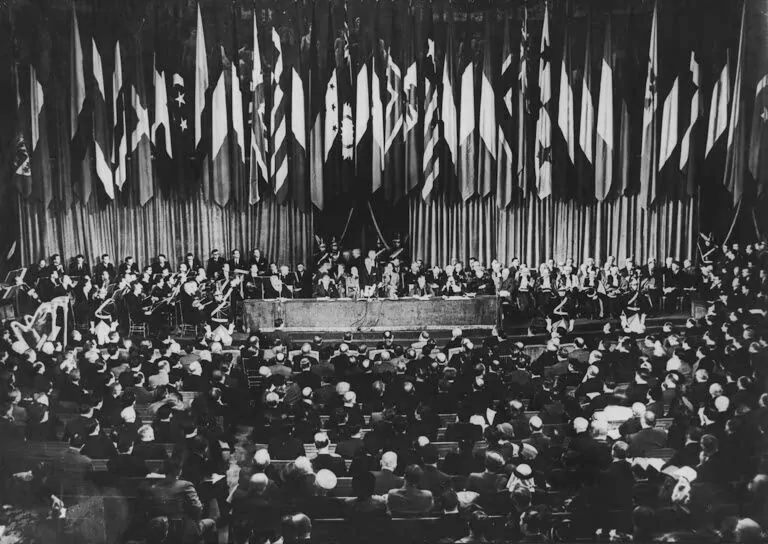
Here are some of the most prominent :
- Léon Blum, President of the Provisional Government of the French Republic after his return from Buchenwald, and President of the French delegation to UNESCO
- René Cassin, Rotarian, lawyer, and diplomat, principal contributor to the Universal Declaration of Human Rights three years later, then President of the European Court of Human Rights and Nobel Peace Prize winner
- Robert Debré, pioneer of modern pediatrics and founder of university hospitals
- Frédéric Joliot-Curie, pioneering physicist in the field of fission and Nobel Prize winner in chemistry
- Gustave Roussy, neurologist and oncologist, founder of the institute of the same name
- Paul Langevin, physicist, inventor of sonar, and supporter of Albert Einstein
- Léopold Sédar Senghor, poet, writer, and first president of the Republic of Senegal
- Louis Jouvet, actor, director, theater manager, and professor at the Conservatoire National Supérieur d'Art Dramatique
Rotary maintains its commitment
In the same way as with the United Nations Charter and the booklet «From here on!», Rotary International will publish an explanatory booklet on the UNESCO Charter, titled «In the Minds of Men» in 1946, which would be distributed to all clubs in the world – already nearly 6000 at that time.
These two books, among others published by Rotary International and widely distributed, greatly contributed to quickly raising awareness among institutions in many countries about the importance of the movement that had just been launched.
Rotary then obtained official consultative status with UNESCO in 1948, allowing it to participate in UNESCO conferences, propose initiatives, and collaborate directly on projects related to education, culture, and peacebuilding efforts. Scholarships for UNESCO programs were awarded by The Rotary Foundation as early as 1948.
This special relationship is maintained today through the ongoing work of the Rotary Representatives Network, established in 1991, but also through funding from scholarships at the IWE since 2011, as well as numerous educational and cultural projects led by Rotary clubs.
Since its first class in 2004, the Rotary Peace Fellowships has been training students from around the world, many of whom have gone on to pursue careers with international organizations such as UNESCO.
Rotary International and UNESCO also organize major conferences that highlight their collaboration on topics such as culture, education, science, and environmental protection. These conferences, open to all, take place every two years at the UNESCO House in Paris, and hold both historical and symbolic significance.
For a complete report of the 2024 edition, Click here.
The 2026 edition will take place on March 14. Official website: leforumdurotary.org
80 years of initiatives
Since its creation, UNESCO has played a crucial role in preserving the world's cultural and natural heritage, notably through the adoption of the World Heritage Convention in 1972, which today protects more than 1,200 sites around the world, including 54 in France. It has coordinated international campaigns such as the preservation of the Abu Simbel temple in 1960, and supports education and literacy programs to promote universal access to culture and science.
In 1951, a conference led to the creation of CERN, whose primary goal of bringing European scientists together quickly evolved into international collaborations that resulted in numerous fundamental discoveries and major innovations, such as the construction of the LHC, the discovery of the Higgs boson, work on antimatter, and the design of the internet.
In 1961, UNESCO created the Intergovernmental Oceanographic Commission, which since its inception has enabled unprecedented international cooperation on ocean protection, the implementation of sustainable fishing practices, seabed mapping, and the tsunami warning system. With 150 member states, the system has saved thousands of lives since its inception in 1965.
Among the more recent programs, we can mention work on the ethics of the human genome and cloning, the safeguarding of intangible heritage, or recommendations on AI ethics.
Article author: Pierre-Marie Achart
Rotary Paris Agora (2025)

Published in november 2025 under Creative Commons Attribution-NonCommercial-ShareAlike 4.0.
Bibliography: UNESCO Archives, UNESCO Digital Library, UK National Commission for UNESCO, Permanent Delegation of Portugal to UNESCO, Luxembourgish Commission for UNESCO, The Rotarian, The National Rotarian, My Road to Rotary – Paul Harris, Serge Gouteyron's Blog, From Here On! – Rotary International, The World at Work – Rotary International, History and Stories of Rotary – Marc Levin and Christophe Courjon, The Founder of Rotary – James P. Walsh, The Golden Wheel – David Shelley Nicholl, Adventure in Service – Rotary International, Rotary International: 120 Years of History – Arnaud Berthonnet, Seven Paths to Peace – Rotary International, Rotary Basic Library – Rotary International.
 Français
 English