
From Havana to the Palais de Chaillot : the origins of the Universal Declaration of Human Rights
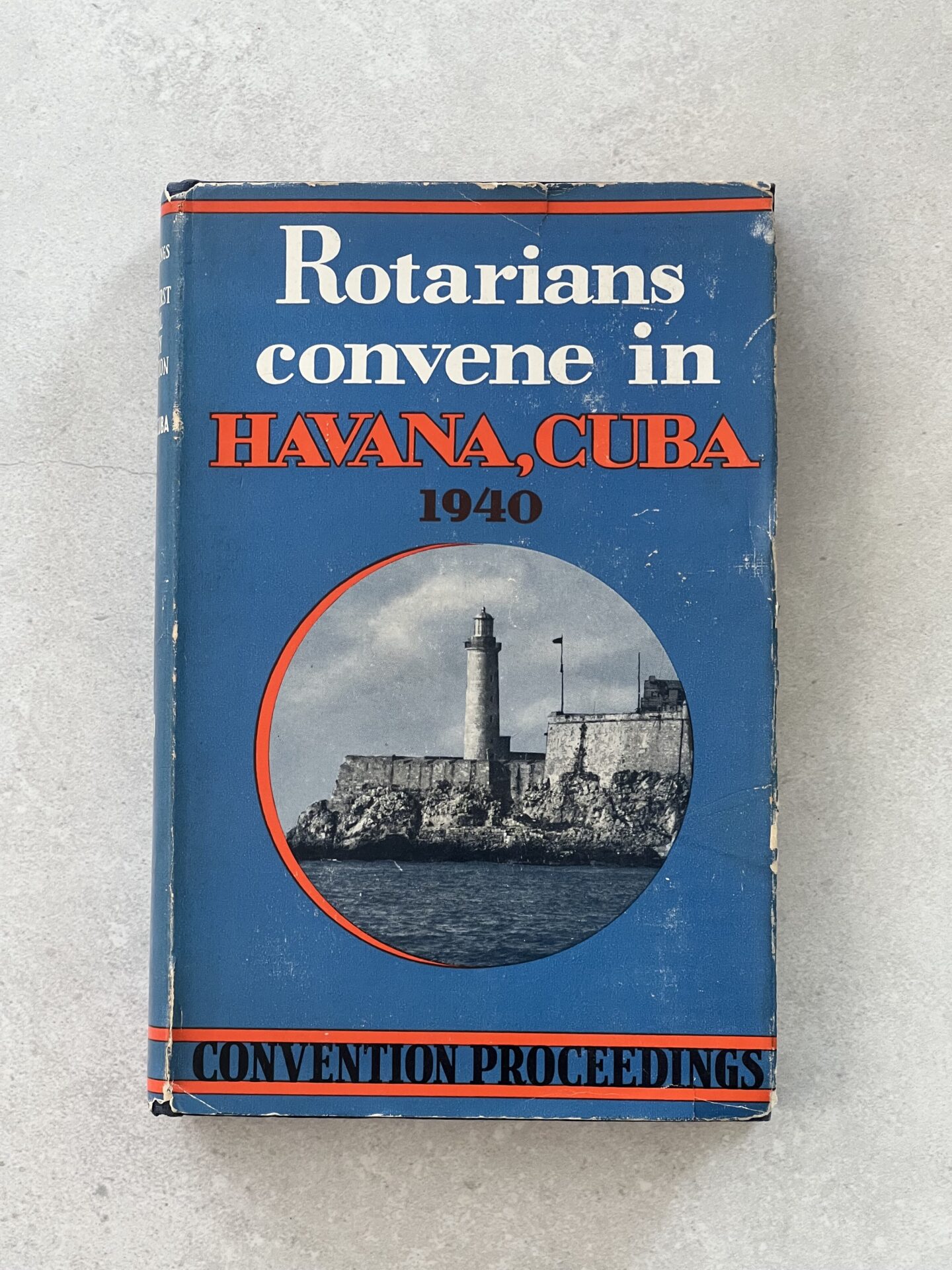
The year 1940 was a dark one for Europe. World War II was in full swing: many countries were plunged into uncertainty, occupied or threatened, and international communications were difficult. It was in this tense context that the 31st annual convention of Rotary International was held in Havana from June 6 to 10. Many European Rotarians were unable to attend due to hostilities and border closures.
At the heart of this extraordinary convention is born the famous Resolution 40-15, «Rotary Amid World Conflict». Evoking the war that is already raging in a third of the countries where Rotary International is present, the Board of Directors recalls that the organization, founded on the ideal of service, « cannot survive where freedom, justice, truth, the value of a given word, and respect for human rights do not exist«This is the excerpt most often cited when researching the origins of the Universal Declaration of Human Rights.
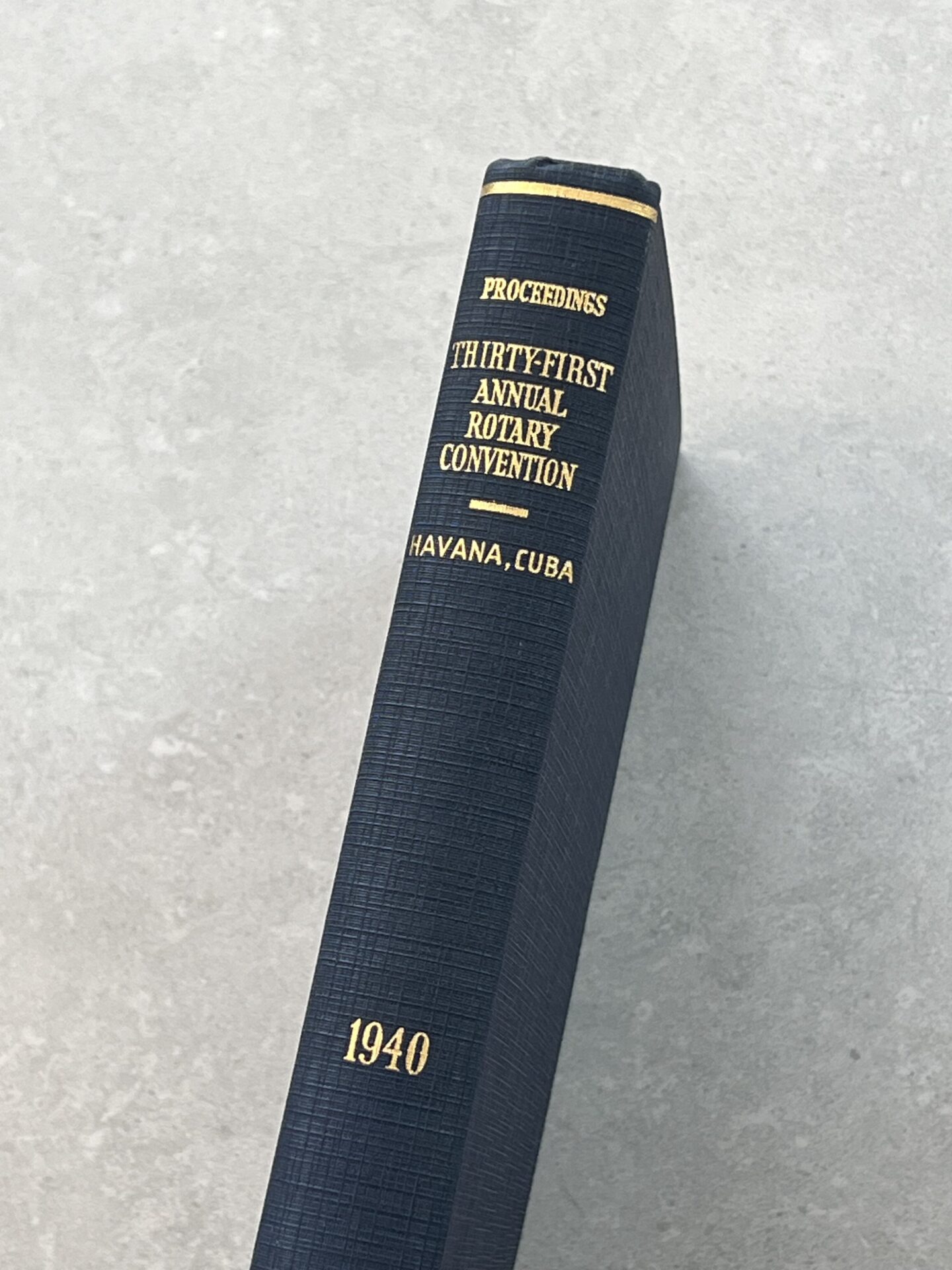
The entire text of this resolution is published in the work « Proceedings of the Thirty-First Annual Rotary Convention« .
Since 1910, these books, each around 400 pages long, have provided a comprehensive account of the major speeches, various addresses, and deliberations of the Council on Legislation. The last of these books was published on the occasion of the 2010 Convention.
It is in this work, from my personal collection, that I was able to find the complete text. I have transcribed it below in its entirety, and I also offer a translation into French.
Today, international convention reports are archived in Rotary's records, posted on its website (here), and videos are published on social media.
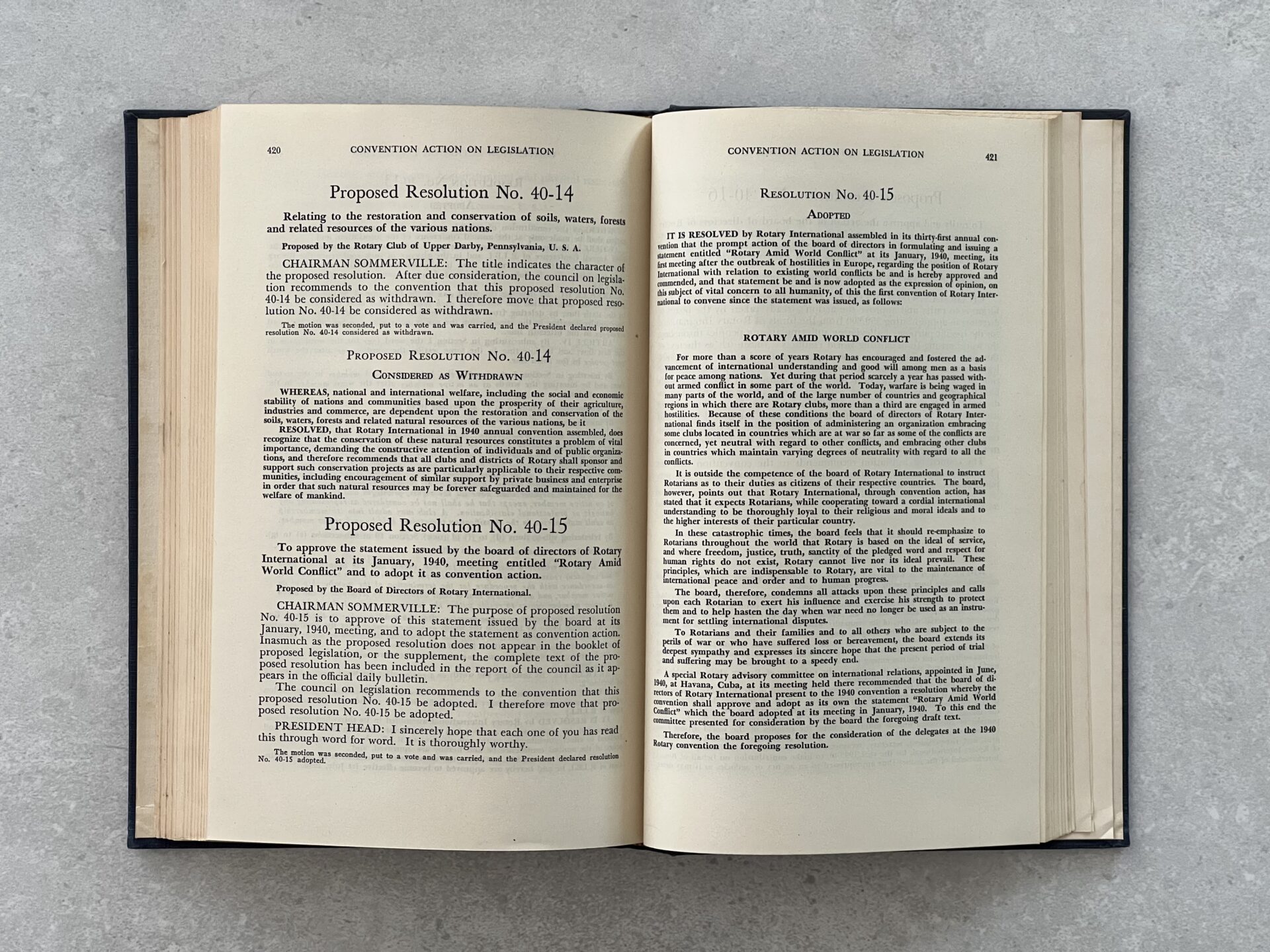
This powerful text condemns any violation of universal principles and calls on every Rotarian to defend them tirelessly, in the hope of a world where war would cease to be a means of resolving disputes. Resolution 40-15 would go down in history and become an ethical foundation that paved the way for the future Universal Declaration of Human Rights (UDHR), adopted in 1948.
It is precisely in this context that René Cassin, French lawyer and Rotarian, professor of law and pacifist activist, member of the Académie des sciences morales et politiques (Academy of Moral and Political Sciences), comes to the fore. Born in 1887 in Bayonne, he is a veteran of the First World War.
He was a founding member of the Rotary Club of Lille in 1927, then a member of the Paris club from 1931 onwards. René Cassin embodied the Rotary spirit. Demonstrating great international openness, he campaigned from the 1920s onwards for closer ties between France and Germany. He was also deeply committed to the cause of veterans.
After World War II, he joined the United Nations Commission on Human Rights and became one of the principal drafters of the UDHR, giving this founding text its structure, philosophical coherence, and universal scope.
He was awarded the Nobel Peace Prize in 1968, as well as the United Nations Human Rights Prize. His commitment continued within other institutions such as the Constitutional Council and the Council of Europe, and he served as President of the European Court of Human Rights.
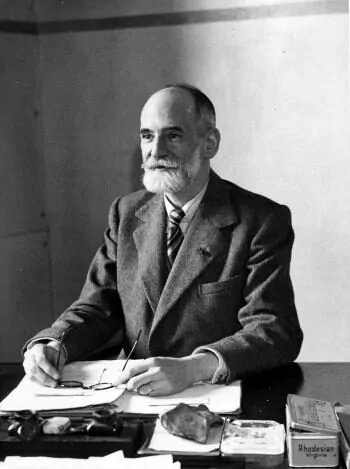
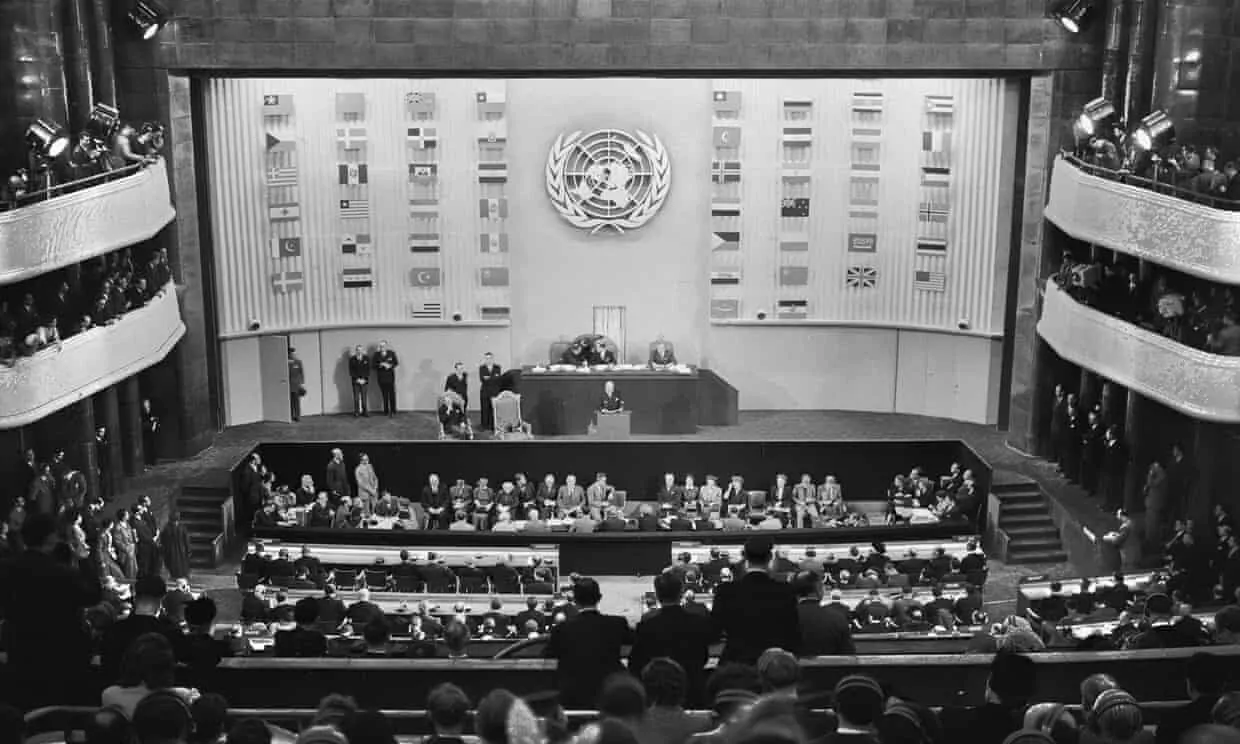
On December 10, 1948, the 48 member states of the United Nations present at the General Assembly signed the text at the Palais de Chaillot in Paris, in a solemn atmosphere.
René Cassin is entrusted with the responsibility of presenting the document to the Assembly.
The link between Resolution 40-15 of Havana and the Universal Declaration of Human Rights is now well established. The wording and spirit of Rotary's text directly inspired the drafters of the UDHR.
The concept of "human rights," still rare at the time, spread among international lawyers and decision-makers thanks to the commitment of figures such as René Cassin. Thus, while Rotarians regretted the absences at the 1940 International Convention, they initiated, in adversity, the texts that would shape the postwar world. Resolution 40-15 remains an essential milestone: a declaration of principle, a cry against war, and a model whose influence extends to the Universal Declaration of Human Rights and beyond.
Article author: Pierre-Marie Achart
Rotary Paris Agora (2025)

Published in august 2025 under Creative Commons Attribution-NonCommercial-ShareAlike 4.0.
Bibliography: Rotary.org, convention.rotary.org, Serge Gouteyron's Blog, Rotary Global History Fellowship, Academy of Moral and Political Sciences, Rotary-Ribi.org, rotarygbi.org, Memorial-Rotary.de, UN.org, unfoundation.org, nobelprize.org, britannica.org, delegfrance.org, ordredelaliberation.fr
 Français
 English